

Co-Author Introduction
I’m honored to co-author this piece with Rick Weijers, an innovative HR consultant specializing in Digital HR & AI Transformation. Rick brings deep experience as an HR Program & Project Manager at leading organizations, including ING, AkzoNobel, and The Adecco Group, through his role on the Platinum-ranked Quintop consultancy team. He partners with executives to embed digital HR strategies that align talent development with business goals and prepare organizations for AI-driven transformation.
As a Learning & Development Partner, I design leadership programs grounded in adult learning science and modern leadership frameworks. Through my done-for-you Leadership Systems and L&D Retainer Partnership, I help companies develop confident, capable leaders, strengthen retention, and save over €60,000 a year. Each program blends assessments, personalized learning paths, and real-world application to build strategic thinking, emotional intelligence, and team performance, all supported by AI-enabled tools and behavioral science.
Combining Rick’s strategic HR vision with my L&D expertise, we offer a holistic approach to building AI-ready leadership at scale.
L&D Perspective: Designing AI Leadership Development That Sticks
The data is clear: executives may prioritize AI adoption, but many still lack the confidence and capability to lead effectively. Addressing this requires more than traditional training. It demands a sophisticated L&D approach rooted in adult learning and behavior-change science.

Why L&D Must Partner with Leadership on AI Development
True AI transformation is not a technology rollout. It is a complex behavior-change initiative grounded in adult learning principles. Success hinges on intentional CEO, HR, and L&D collaboration, because leaders are not just strategy consumers. They are change agents whose own actions shape adoption. Research highlights that transformational initiatives are five times more likely to succeed when senior leaders model new behaviors rather than merely endorse them.
Partnering with L&D Is Essential
Adult executives learn best through experiential, peer-based, and problem-centered learning. When leadership invests visibly in structured learning, it normalizes vulnerability and fosters authentic development.
CEOs as Co-Leaders of Immersive AI Learning
Bandura’s social learning theory confirms that adults adopt new behaviors more readily when respected peers model them. Without visible executive participation in AI learning, even well-funded initiatives risk faltering in pilot phases.

L&D Application Framework: Transforming AI Adoption Through Learning Design
Consider a service-based organization aiming to deploy AI-enabled forecasting in customer service. Leadership skepticism and lack of shared understanding often stall these efforts. Here’s how an evidence-based L&D “AI Development Journey” can build sustained executive capability.
Phase 1: Foundation Building
Start with confidential competency assessments using Kirkpatrick’s model to benchmark C-suite AI knowledge and set personalized goals.
Phase 2: Experiential Learning
Run a full-day immersive simulation using company data, guided by Kolb’s experiential learning cycle: concrete experience, reflective observation, conceptualization, and experimentation.
Phase 3: Applied Practice
Use monthly, function-specific workshops where department heads work hands-on with Generative AI tools, reinforcing learning over time with Ebbinghaus’s spacing effect.
Phase 4: Peer Learning
Facilitate structured After Action Review sessions where executives discuss AI experiments in terms of expectations, outcomes, discrepancies, and lessons learned.
Expected Outcomes Framework
Using Kirkpatrick’s four-level evaluation model, organizations can expect measurable results.
- Level 1 (Reaction): Executives report high satisfaction when learning is relevant and engaging.
- Level 2 (Learning): Improved AI competencies are demonstrable through post-training assessments.
- Level 3 (Behavior): Executives actively engage with AI tools and incorporate them into strategic discussions.
- Level 4 (Results): AI adoption succeeds, driving employee engagement and improving retention as leaders model desired behaviors.
Why This Framework Works
This method creates lasting behavior change, not fleeting curiosity, by treating AI adoption as a complex transformation. It hinges on:
- Strategic alignment: Ties learning directly to executives’ immediate business challenges.
- Experiential focus: Hands-on practice builds confidence rapidly.
- Measurement integration: Feedback loops reinforce learning and surface gaps.
- Social learning: Peer interaction supports experimentation and reduces resistance.
The framework aligns with the 70-20-10 development model: 70% experiential, 20% social, and 10% formal instruction.

L&D Implementation Guide: Your 90-Day Executive AI Development Program
Days 1–30: Learning Needs Analysis & Program Design
- Conduct executive AI competency assessments.
- Apply the ADDIE model to craft tailored learning paths.
- Secure joint CEO, HR, and L&D sponsorship with clear success metrics.
- Pinpoint two to three strategic AI integration priorities aligned with business impact.
Days 31–60: Experiential Learning Implementation
- Launch problem-based AI labs for each function.
- Host peer learning communities with structured reflection protocols.
- Track progress with pre and post competency assessments and behavioral observations.
- Deliver weekly microlearning sessions with actionable AI skill-building.
Days 61–90: Sustained Development & Transfer
- Embed AI competencies into leadership performance reviews using behaviorally anchored rating scales.
- Launch cross-functional AI mentoring, pairing high-adopters with developing leaders.
- Establish ongoing learning pathways featuring spaced repetition and just-in-time resources.
- Conduct formal program evaluation using Kirkpatrick’s evaluation framework.
This timeline follows Gagné’s Nine Events of Instruction, ensuring each phase builds cumulatively while keeping executives engaged with relevant, real-world challenges.
Recent data underscores the urgent need for this work. Eighty-eight percent of global C-suite leaders identify speeding up AI adoption as a top priority for 2025. Yet four in ten see leadership teams as the primary barrier, citing lack of AI training, vision, or confidence as key gaps. This ambition-capability gap crystallizes the human and leadership dimension of AI adoption.
The C-Suite’s AI Ambition vs. Reality Gap
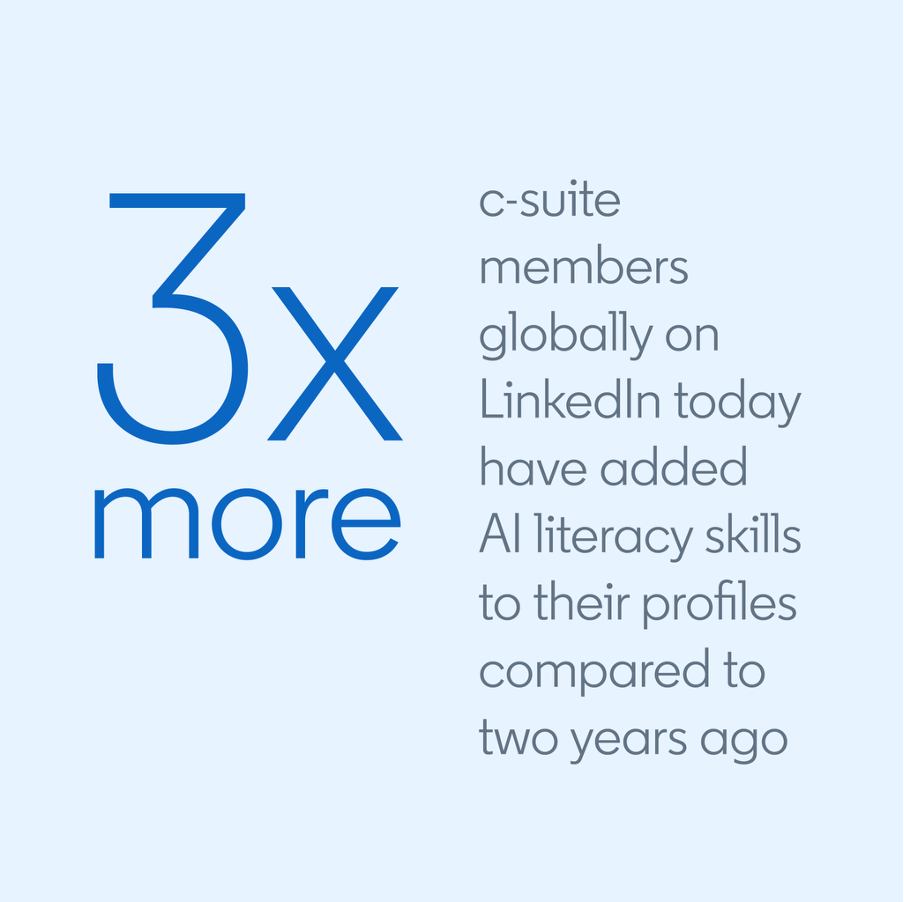
C-suite members are eager. Three times more leaders today list AI skills, such as prompt engineering and generative AI, on their LinkedIn profiles than two years ago. Boards and investors are pushing, as 51% of companies integrating AI report at least a 10% revenue boost. AI fluency has become the top skill for navigating change, and eight in ten executives prefer AI-savvy hires even over more experienced candidates.
Yet the leadership team is not always ready. Nearly 58% of VP-level leaders have had no AI training, only 42% feel confident using AI tools securely, and 39% lack the knowledge to make informed AI decisions. The gap between aspiration and execution is stark, and HR must lead the breakthrough.
Why HR Must Lead the AI Upskilling Agenda
If AI adoption is, at its core, a people and change-management challenge, then HR holds the essential levers — culture, development, and organizational learning — to turn AI from buzzword to business value. HR must rise.
- HR shapes leadership development and culture change. By embedding AI competency into development programs, succession planning, and performance reviews, HR ensures leadership meets digital expectations. Today’s leaders must role-model AI usage and inspire their teams.
- There is multi-stakeholder urgency. The EU’s AI Act classifies many HR technologies as high-risk, demanding robust oversight. Meanwhile, shareholders and CEOs expect AI-driven growth, and employees, especially emerging talent, expect leaders who understand AI. AI literacy is not optional. It is strategic.
- HR can bridge ambition and capability. HR professionals know how to demystify AI, highlight quick wins, and manage the mindset shift from fear to exploration. Leadership transformation is not just workflow change. It is habit transformation, and HR drives that.
With HR in the lead, the C-suite becomes a driver of AI and not its roadblock.

HR’s Playbook: How to Build AI-Ready Leaders
1. Audit the C-suite’s AI literacy.
Establish where leadership stands via self-assessments or 360 feedback focused on digital acumen. Identify who knows AI basics, who understands existing AI initiatives, and tailor development accordingly.
2. Model AI leadership and become the Chief AI Evangelist.
HR leaders should adopt AI in daily workflows and share those wins publicly. From drafting policy using GenAI to automating analysis, demonstrating AI in action shifts skepticism to curiosity.
3. Provide executive-friendly AI training.
Accessible, strategic-first courses are now available, many free. LinkedIn (with Microsoft) offers “AI for Organizational Leaders” and “AI for Managers” certificates free through December 31, 2025. LinkedIn Learning also offers more than 150 courses free until July 31, 2025. Host AI bootcamps — short workshops or lunch-and-learns — to make learning mandatory, relevant, and leadership-focused.
4. Embed AI into leadership competencies and succession.
Update competency frameworks with AI literacy, data-driven decision-making, and a tech-savvy mindset. Link promotions and performance to AI-related KPIs, such as quarterly AI pilots or productivity improvements, and integrate AI fluency into succession planning.
5. Create a cross-functional AI task force with HR and IT co-leading.
Partnership is key. Pair HR with CIOs or data leaders to sponsor AI adoption. HR ensures adoption is people-centered, and tech ensures technical viability. Together, pilot use cases, build ethical guidelines, and align on strategic rollout.
6. Cultivate a culture of continuous AI learning.
Build forums for AI experimentation, such as monthly roundtables where leaders share wins and failures. Celebrate small breakthroughs, like five hours saved or a model built in minutes. Keep curricula current and tie AI adoption to corporate values like agility and innovation. When AI becomes a rewardable norm, leadership champions it.
Conclusion: HR Leaders as AI Champions
AI adoption starts with technology, but succeeds or fails with leadership. HR’s mission is to ensure our CEOs, CFOs, COOs, and ourselves become confident AI leaders — agile, data-savvy, and future-facing. Think beyond HR. Think as your organization’s Chief AI Evangelist, rallying the C-suite to embrace AI’s potential. The path, from auditing capability and mandating training to embedding AI in leadership DNA and cross-functional partnerships, is just the beginning. HR must now drive AI fluency at the top. The payoff is significant: adaptable leaders, smarter decisions, breakthrough efficiency, and expanded revenue. Organizations without AI-ready leadership risk falling behind, even with hefty tech budgets. So let’s act. Encourage an AI upskilling initiative this quarter, however small. Share your challenges and triumphs. Together, we refine this playbook and elevate C-suite AI capability. AI moves fast. With leadership, HR, and L&D in step, organizations can move faster. The future of work is being written now, and HR plus L&D hold the pen. Let’s ensure our leaders do not just adapt, but shape what comes next. The era of the HR and L&D-led AI revolution is here. Let’s lead the way. If you would like to explore how this can look in your organization, feel free to connect with Rick Weijers and me — we’re always open to a conversation.
Join the Newsletter – Gen L: Leadership, Learning & Leverage
Get high-impact learning insights in your inbox.
- Real tools for onboarding & team culture.
- Behind-the-scenes from the field.
- Proven strategies to train confident teams.
No spam. Unsubscribe anytime using a link in a newsletter mail.